


The first social media report I sent a client as a freelancer was a full page of numbers. Reach, impressions, follower growth, engagement rate, post frequency—every metric the platform dashboard would give me, neatly formatted and sent across with something close to pride.
The client stared at it for a moment, then looked up and asked what any of it had to do with their sales.
I didn’t have a good answer. The data was accurate, and the report was thorough. But it didn’t connect to anything the client actually cared about, and it hadn’t occurred to me that the link between “here are your numbers” and “here’s what they mean for your business” was the entire job.
That moment changed how I think about social media analytics—and it’s the same gap I see in organisations of every size, more than a decade later. The data is almost never the problem. Knowing what to do with it is.
What social media analytics actually is (and what it isn’t)
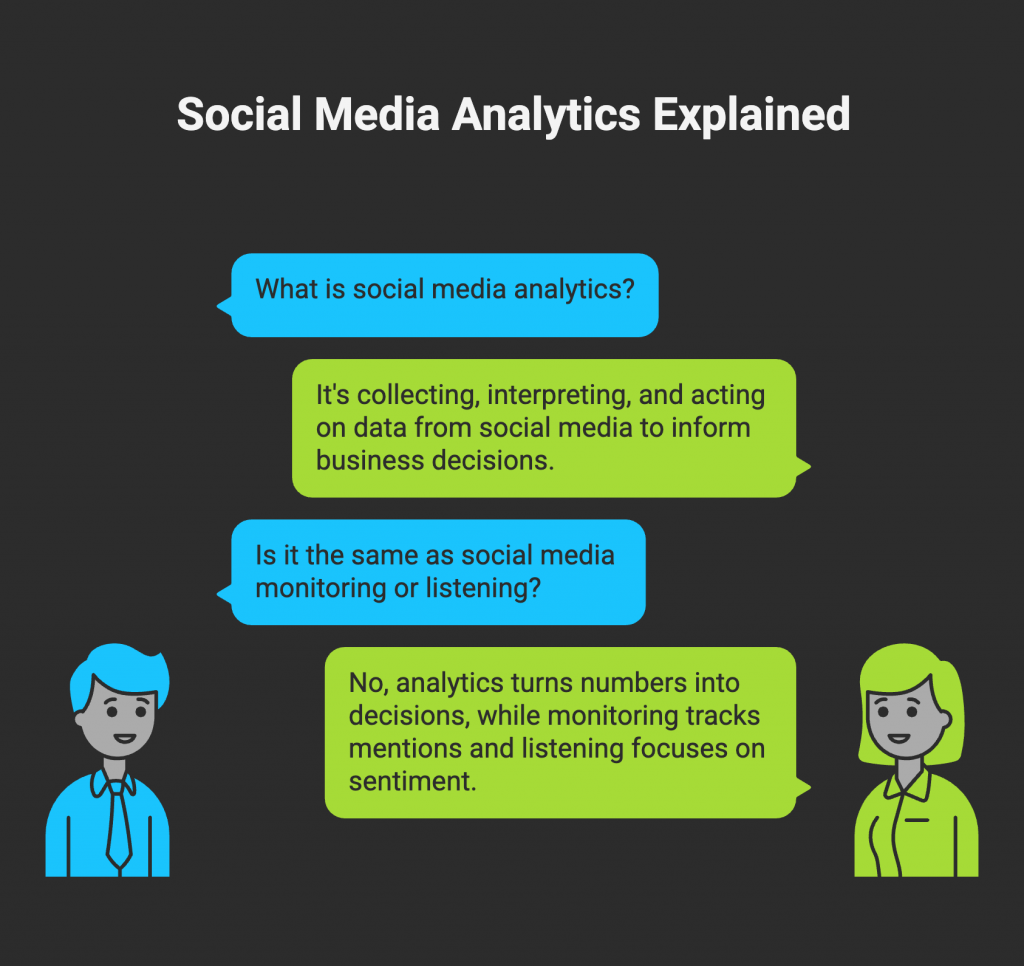
Social media analytics is the practice of collecting, interpreting, and acting on data from social media platforms to inform business decisions.
It’s not the same as social media monitoring, which is the passive tracking of mentions and activity, or social listening, which focuses on brand sentiment and the qualitative texture of what people are saying.
Analytics sits upstream of both: it’s the discipline of turning numbers into decisions.
There’s a difference between metrics that are easy to produce and actually useful metrics. Likes, follower counts, and impressions are easy to surface and easy to put in a report. They’re also largely disconnected from business outcomes.
Engagement rate, click-through rate, conversion rate, cost per result, and share of voice are harder to explain to a sceptical stakeholder—and considerably more useful for making decisions.
| Vanity metrics | What they tell you | Business-connected metrics | What they tell you |
| Follower count | How many accounts follow you | Engagement rate | How actively your audience interacts with content |
| Impressions | How many times content was displayed | Click-through rate | How often viewers take action |
| Likes | Passive positive response | Conversion rate | How often social drives a measurable business outcome |
| Post reach | Unique accounts who saw a post | Cost per result | Efficiency of paid or organic investment |
| Profile visits | Passive interest signal | Share of voice | How visible your brand is relative to competitors |
I spent my PhD researching social media analytics and business intelligence, which means I’ve been thinking about this problem at both a theoretical and applied level for a long time. The conclusion is the same whether you’re looking at it academically or practically: data that doesn’t answer questions is noise.
What good social media analytics training covers
Most social media analytics courses on the market cover platform navigation and metric definitions. That’s useful as a starting point and not much further.
Here’s what analytics training needs to cover to actually change how a team works:
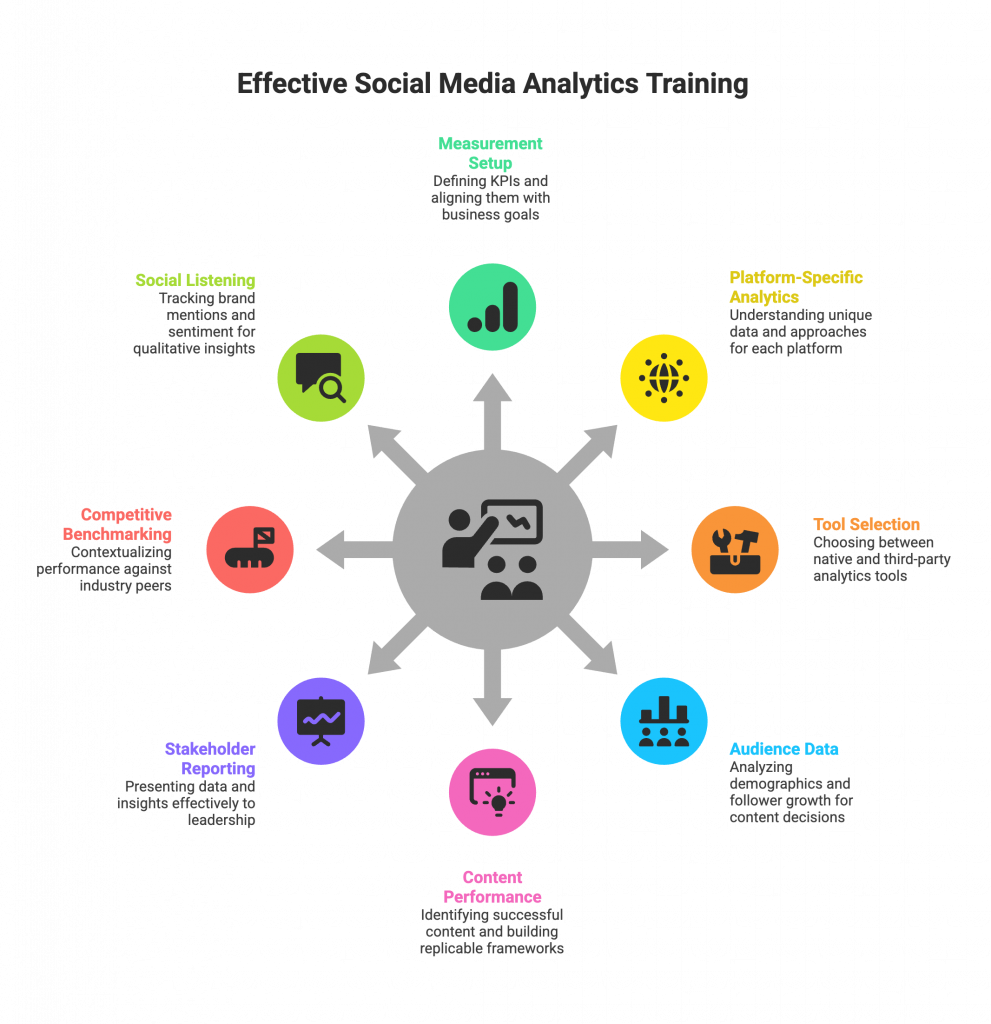
Setting up for measurement. Before touching any dashboard, a team needs to define what it’s measuring and why. KPIs should connect directly to business goals—not to what the platform makes easy to track. A consumer brand measuring brand awareness needs different metrics than a B2B firm measuring pipeline contribution. Training that skips this step produces people who can read dashboards but can’t explain what they’re looking for.
Platform-specific analytics. LinkedIn, Meta Business Suite, TikTok analytics, and X analytics all surface data differently, use different terminology, and reward different interpretive approaches. Training should cover the platforms the team actually uses rather than working through every channel in generic sequence.
Native vs third-party tools. Platform dashboards are sufficient for most small and mid-size organisations. Tools like Sprout Social, Hootsuite, or Brandwatch add value at scale—particularly for cross-channel reporting, competitive benchmarking, and social listening integration. Training should help teams understand when native analytics is enough and when to invest in a third-party tool.
Audience data. Demographic breakdowns, follower growth patterns, reach vs impressions, and the difference between a growing audience and a relevant one—these distinctions matter for content decisions, but rarely get the attention they deserve in generic courses.
Content performance analysis. Identifying what’s working, understanding why, and building a replicable framework for future content decisions is the applied core of analytics training. This includes recognising content that looks successful on the surface but doesn’t connect to business outcomes—a skill that takes practice to develop and is almost impossible to teach without using live data.
Reporting for stakeholders. This is where most social media teams lose credibility with senior leadership. A report that lists metrics without connecting them to decisions is merely a data dump. Training should cover how to structure a performance review, how to frame insights as recommendations, and how to present data to people who don’t live in platform dashboards.
Competitive benchmarking. Using publicly available data and third-party tools to contextualise performance against sector peers is a skill most organisations don’t develop until they’ve been embarrassed by a competitor’s results in a board meeting. It should be part of any social media analytics course or workshop.
Social listening fundamentals. Tracking brand mentions, measuring sentiment, and understanding how qualitative signals sit alongside quantitative data rounds out a team’s analytical picture. It’s increasingly expected as part of a competent social media function.
Who social media analytics training is right for
| Role / team type | Primary gap analytics training addresses | Recommended training format |
| Social media managers | Reporting by instinct rather than data; content decisions not grounded in performance analysis | In-house workshop or one-to-one coaching |
| Marketing managers & directors | Can’t interrogate reports confidently; unable to hold team accountable to meaningful KPIs | Half-day tailored session or ongoing coaching |
| Comms & PR teams | Need to measure social amplification of campaigns and report on reach and sentiment to clients | Workshop covering campaign analytics and reporting |
| In-house digital teams | Grown social presence without a measurement framework behind it | Full-day workshop to build reporting infrastructure |
| Agencies & freelancers | Need consistent, defensible reporting across multiple client accounts and sectors | One-to-one or small group coaching |
| Public sector & research organisations | Must demonstrate public engagement and evidence reach to funders or ministers | Tailored workshop with public sector framing |
Public sector and research organisations have their own specific analytics requirements: demonstrating public engagement, evidencing reach to funders or ministers, and interpreting audience behaviour data in the context of policy rather than commercial objectives.
I’ve trained teams in this space directly, and the framing of analytics for public sector audiences requires a different approach than commercial training assumes.
The difference between a course and actually useful training
Generic vs tailored. A course designed for everyone is optimised for no one. Useful analytics training starts by understanding which platforms the organisation uses, what decisions the data needs to support, and what the team’s current capability level is. Those three answers should frame everything that follows.
Theory vs application. Being told what engagement rate means is different from being walked through your own account’s data and understanding what it’s telling you about a specific content decision. The best analytics training uses live data from the client’s own channels—not hypothetical examples from a made-up brand.
Tools-agnostic thinking. Training that teaches you to navigate one specific tool is less durable than training that teaches analytical thinking that applies regardless of which dashboard the data sits in. Platforms update their interfaces; the underlying questions you should be asking don’t.
One session vs ongoing development. A single workshop builds awareness and gives a team a framework to start from. Recurring coaching builds the habit of data-informed decision-making, which is what actually changes how an organisation behaves. The two serve different purposes and shouldn’t be treated as substitutes.
Certification vs competence. A certificate from a course platform is a reasonable credential for a CV. It doesn’t necessarily indicate the ability to run a quarterly social media performance review, identify why a content strategy isn’t generating leads, or present analytics findings to a board. Ask any training provider what participants will be able to do differently the week after the session, not just what they’ll receive at the end of it.
Questions to ask before booking social media analytics training
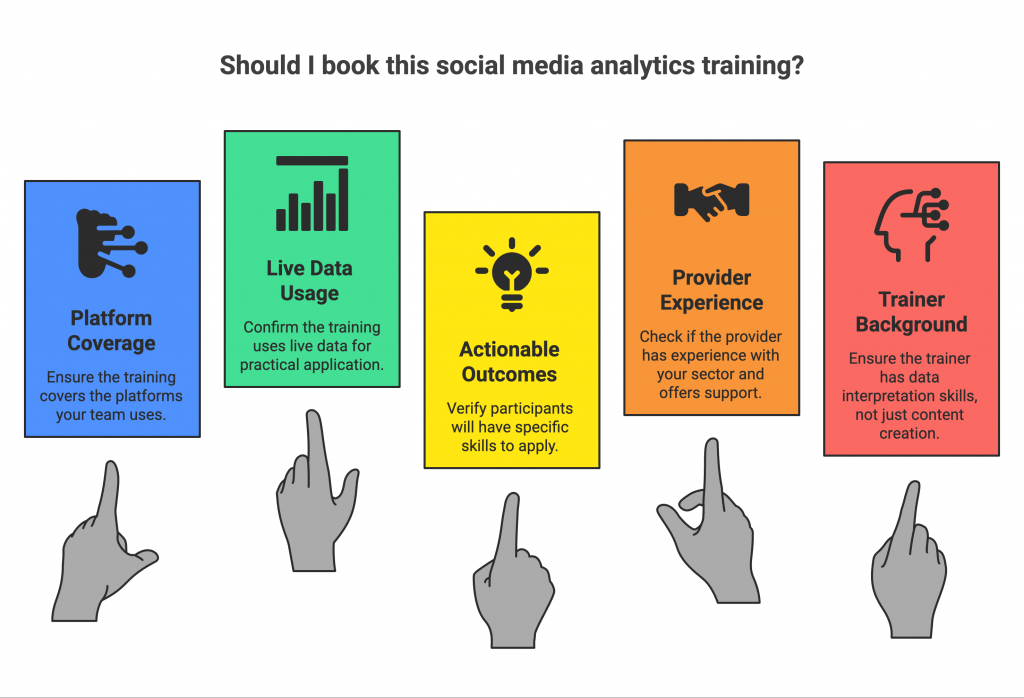
- Which platforms will the training cover, and are they the ones your team actually uses?
- Will sessions use live data from your own accounts or generic examples built for a hypothetical brand?
- What will participants be able to do differently the following week—specifically?
- Does the provider have experience with organisations in your sector, or with teams at your current capability level? Is follow-up support available after the initial session?
- And—specific to analytics—does the trainer have a background in data interpretation and business intelligence, or primarily in content creation and platform management?
The answer to that last question matters considerably for whether the analytical depth of the training will be sufficient.
How much does social media analytics training cost?
Pricing varies considerably depending on format, depth, and how tailored the training is to your organisation.
| Format | Typical price range | Best suited to | Limitations |
| Self-paced online course | Free – £400 | Individuals building foundational knowledge | No personalisation; generic platform examples |
| One-day group course | £200–£500 per delegate | Teams needing a baseline across the board | Standardised delivery; limited sector tailoring |
| In-house half-day workshop | £800–£2,000 | Small teams with a defined gap to close | Less depth; works best with clear pre-brief |
| In-house full-day workshop | £2,000–£5,000 | Groups of 3+ needing a shared framework | Higher upfront cost; requires team availability |
| One-to-one coaching | £100–£250/hour | Managers and directors building data literacy | Most useful as a series, not a single session |
| Ongoing monthly coaching | £300–£600/month | Teams building sustained analytical capability | Requires ongoing time commitment |
The right format depends less on budget and more on where the team is starting from. A team with no analytics baseline needs foundational training before anything more advanced; a team that already tracks data but can’t act on it needs a different kind of session entirely.
Social media analytics training vs hiring an analyst
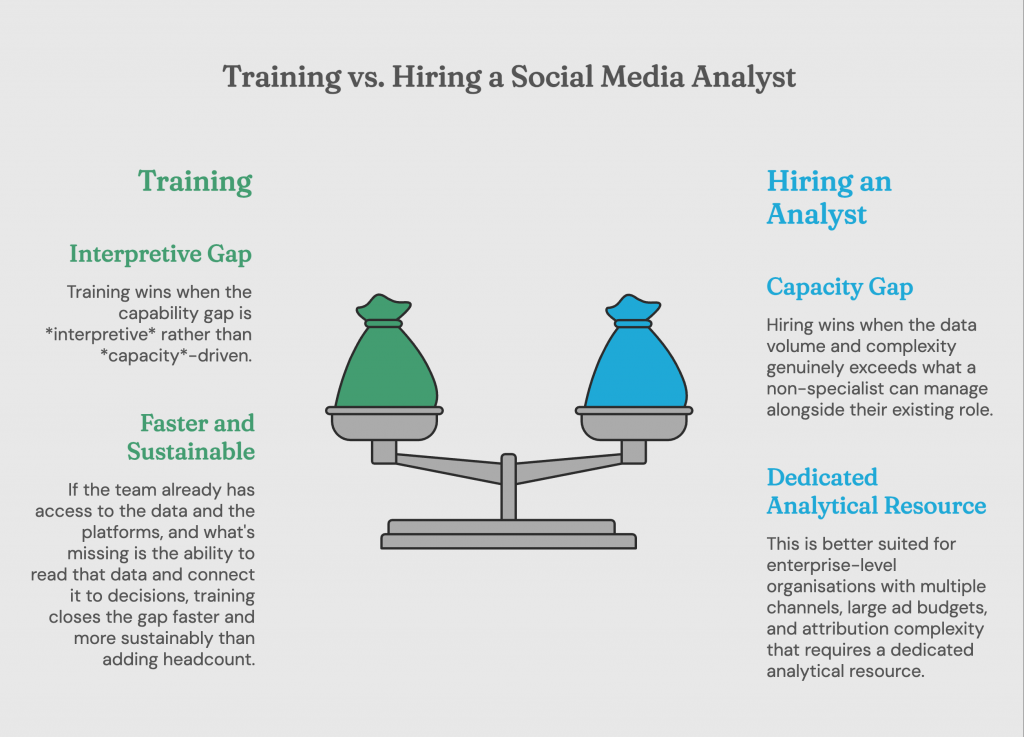
Training wins when the capability gap is interpretive rather than capacity-driven. If the team already has access to the data and the platforms, and what’s missing is the ability to read that data and connect it to decisions, training closes the gap faster and more sustainably than adding headcount.
Hiring wins when the data volume and complexity genuinely exceeds what a non-specialist can manage alongside their existing role. This is better suited for enterprise-level organisations with multiple channels, large ad budgets, and attribution complexity that requires a dedicated analytical resource.
The approach that works well for most organisations is a hybrid: train the social media manager or marketing team on analytics fundamentals and reporting, and bring in a specialist for strategic interpretation on a quarterly or project basis. That keeps day-to-day analytical capability in-house while ensuring continued upskilling and independent auditing and validation.
If you’ve concluded that outsourcing is the right fit for now, Shehu Social’s social media management service includes analytics and reporting as a core part of the retainer.
Most organisations have more social media data than they know what to do with. The constraint isn’t access, but the analytical capability to turn numbers into decisions.
Good training leaves every participant knowing which numbers to look at, what they mean, and what to do next—which is the only outcome that actually changes how a team works.
Work with me—meet your trainer
I’m Dr. Mo Shehu: I hold a PhD with a research focus in social media analytics and business intelligence, and have spent over a decade training marketing, communications, and PR teams to turn platform data into decisions that drive real business outcomes.

Training sessions from Shehu Social have been booked by individuals at PwC, Accenture, Unilever, the World Economic Forum, Techstars, Wavemaker, and BDO.
Every session is built around your organisation’s platforms, your data, and your team’s current capability—no off-the-shelf content, no generic examples. Live and virtual delivery are both available, for individuals and teams of any size.
To apply or discuss the right format for your team, visit shehuphd.com/training.