


You never want to see your agency in the news because of a misguided social media post by one of your team members. But that scenario, or a version of it, is how most public sector organisations discover they need a social media governance framework.
The smarter move, of course, is to build one before the incident, not in response to it.
Public sector bodies and regulated industries are often in a tough spot. They must manage public trust, legal exposure, and simultaneous scrutiny from ministers, regulators, journalists, and the public.
A single poorly judged post can trigger a ministerial inquiry, regulatory investigation, or front-page story. Social media governance in this context is an operational and compliance requirement, and organisations must treat it as one.
This guide covers what social media governance means in a public sector and regulated industry context, what a framework should include, where it often fails, and how to build one properly.
What Social Media Governance Actually Means
Social media governance is the framework of policies, processes, approval workflows, and role definitions that determines how an organisation uses social media: who can post, what they can say, how the team gets content approved, how it handles incidents, and how it evidences compliance.
It differs from social media management, which covers the day-to-day execution of posting, engaging, and monitoring. Governance sets the rules; management follows them.
It also differs from a social media policy, though organisations often conflate the two. A policy is one component of governance, the foundational document that sets out expectations and boundaries.
Governance is the broader system that gives the policy teeth, including the workflows, training requirements, accountability mechanisms, and audit trail that determine whether the team actually follows the policy, and whether the organisation can demonstrate that it did.
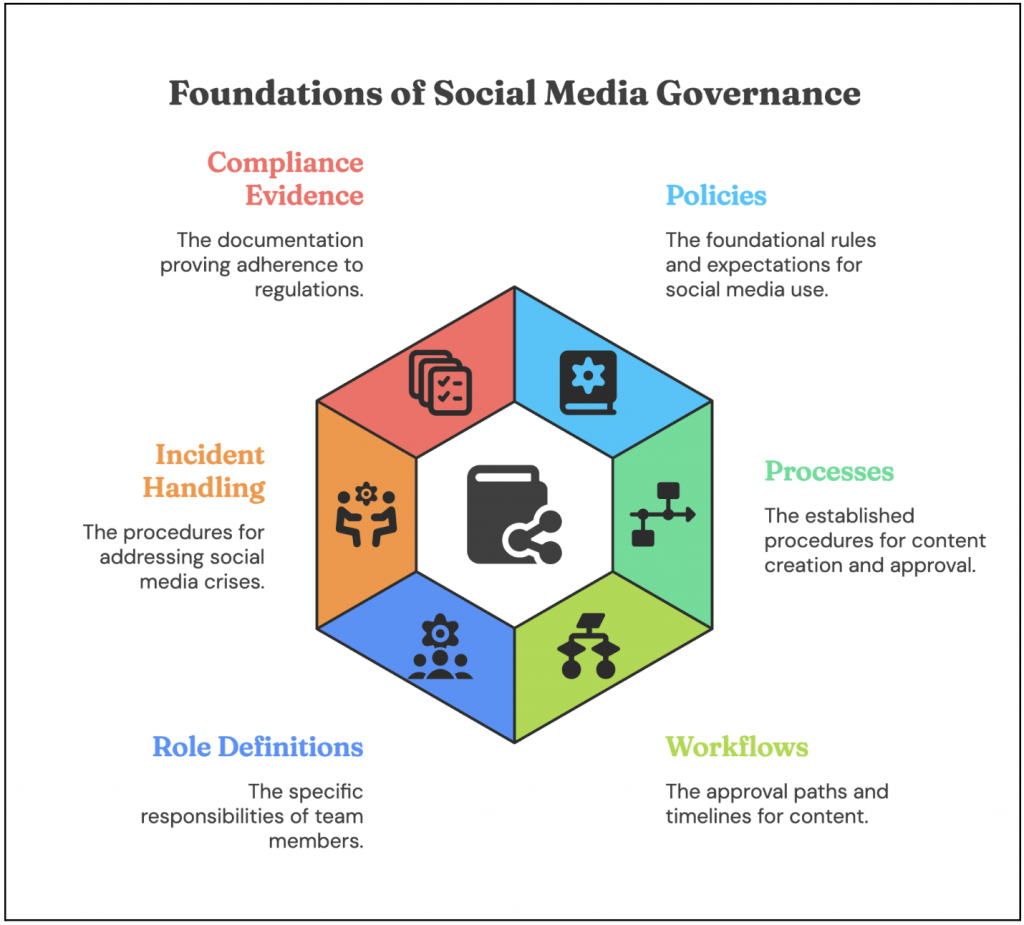
In a public sector and regulated context, the word “governance” signals board-level accountability, audit readiness, and a systematic approach to risk, not a set of guidelines sitting in a shared folder waiting for someone to ignore until something goes wrong.
Why Governance Is A Different Challenge For Public Sector And Regulated Organisations
Most articles on social media governance target commercial brands. These are legitimate concerns, covering reputational damage, brand inconsistency, and legal exposure, but the stakes and the context are categorically different for public bodies and regulated industries.
Public accountability. Public sector bodies answer directly to the public, to elected members, and in many cases to ministers. A tone-deaf post creates a democratic accountability issue, not just a PR one. The higher standard for acceptable conduct means the more visible and more enduring consequences of getting it wrong far exceed anything a consumer brand typically faces.
Regulatory and legal exposure. Financial services firms must comply with FCA guidelines on financial promotions. NHS trusts must navigate patient confidentiality requirements and information governance obligations. Local authorities must consider the FOI implications of their public communications. Each sector carries its own regulatory overlay that a generic social media policy doesn’t begin to address.
Complex internal structures. Large public sector organisations operate multiple departments, directorates, or services, each with distinct communication needs and potentially their own social media accounts. Governance has to function across that complexity without creating a bureaucratic bottleneck that makes the organisation too slow to respond in real time.
Undertrained staff. Commercial organisations typically put social media in the hands of a marketing or comms team. In the public sector, clinical staff, policy officers, social workers, and operational managers sometimes represent the organisation on social media, professionally or personally, without comms training or any awareness of governance requirements. The framework has to account for that reality.
Political sensitivity. Local authorities, government agencies, and arm’s-length bodies operate in environments where social media content attracts a political lens, gets amplified by opposition politicians, or gets picked up by journalists looking for a story. Governance needs to address that exposure explicitly, not treat it as an afterthought.
| Challenge | Why it’s more complex for public sector |
| Public accountability | Answerable to ministers, elected members, and the public simultaneously |
| Regulatory exposure | Sector-specific overlays: FCA, ICO, CQC, Purdah, FOI |
| Internal complexity | Multiple departments, directorates, and accounts to govern |
| Undertrained staff | Non-comms staff representing the organisation without training |
| Political sensitivity | Content read through a political lens by journalists and politicians |
The Core Components Of A Social Media Governance Framework
A governance framework is a system. Here’s what it needs to contain.
Social media policy. The foundational document that sets out what the organisation’s social media presence is for, which platforms it authorises, who manages them, what content is and isn’t appropriate, and what happens when someone breaches the policy. For regulated industries, this document should reference the relevant regulatory requirements explicitly, for example covering FCA rules, ICO guidance, and CQC standards, rather than leaving staff to make that connection themselves.
Role definitions and access controls. Who holds administrative access to which accounts, who has authority to post, who has authority to approve, and what the escalation path looks like. Organisations should tie account access to a role rather than an individual, so that when someone leaves, access doesn’t leave with them. Regular documentation and review should enforce this. This sounds basic, but it’s one of the most commonly neglected elements in practice.
Content approval workflows. A tiered approval process that distinguishes between routine content (lower risk, faster approval path), sensitive or high-profile content (requiring legal or senior comms sign-off), and real-time content (crisis or breaking news, which needs a separate expedited path). Organisations should document and communicate these workflows rather than assume everyone knows the process.
Crisis and incident response protocol. A pre-agreed process for handling reputational incidents, negative press coverage, or regulatory attention that originates on or involves social media. This covers who holds authority to remove or correct content, who speaks on behalf of the organisation, at what point legal gets involved, and how quickly the team should respond. Organisations should not draft this protocol after an incident has already started.
Employee and personal account guidelines. Particularly relevant for public sector organisations where staff post about their work, their views, or their employer on personal accounts, sometimes without grasping the implications. Social media guidelines for government employees should draw a clear line between personal and professional conduct, define what constitutes a breach, and set out what support the organisation provides to staff who receive online abuse in connection with their role.
Platform security protocols. Password management, two-factor authentication, account recovery procedures, and what the team does when a device or account is compromised. Organisations consistently neglect this component more than any other, and it generates some of the most serious incidents as a result. One disgruntled employee or forgotten login can result in a lost account and block comms for months.
Records and audit trail. Regulated organisations need to demonstrate that they approved content, followed governance processes, and handled incidents appropriately. That demonstration requires an evidence base. Archiving requirements and audit trail documentation need to sit inside the framework from the start, not get retrofitted after a regulator asks for evidence.
Training requirements. Governance without training is a document without effect. The framework should specify who needs training, at what level, and how often, and should frame that training as a governance requirement rather than an optional development activity.
| Component | Primary purpose | Who owns it |
| Social media policy | Sets expectations and boundaries | Comms + legal + HR |
| Role definitions and access controls | Prevents unauthorised posting and account loss | Comms + IT |
| Content approval workflows | Ensures appropriate sign-off before publishing | Comms + legal |
| Crisis and incident response protocol | Enables fast, coordinated response to incidents | Comms + senior leadership |
| Employee and personal account guidelines | Manages staff conduct on personal and professional accounts | HR + comms |
| Platform security protocols | Protects accounts from compromise | IT + comms |
| Records and audit trail | Evidences compliance for regulators and auditors | Comms + compliance |
| Training requirements | Makes the framework operational through people | L&D + comms |
Social Media Governance In Specific Regulated Contexts
Generic governance frameworks don’t translate cleanly across sectors. Here’s how the requirements differ in three of the most common contexts.
NHS and healthcare. Patient safety and confidentiality are the primary governance concerns. Governance in an NHS context needs to address what clinical staff can and can’t share publicly, how the trust communicates during patient safety incidents, how to handle complaints that escalate onto social media, and how communications practice aligns with CQC inspection requirements.
Local government. Councils operate under specific legal constraints that don’t apply to commercial organisations. Pre-election periods (Purdah) restrict what can go on official channels. Political neutrality requirements govern how public resources, including communications resource, can be used. FOI implications mean that content decisions, approval processes, and internal communications about social media activity can all become disclosable. Governance frameworks for local authorities also need to address the relationship between elected members’ personal social media activity and the council’s official presence, a boundary that generates frequent confusion and occasional serious incident.
Financial services. FCA rules on financial promotions apply to social media content. Any post that could be construed as promoting a financial product or service needs prior approval from an authorised person before it goes live. Governance in this sector needs to embed the financial promotion approval process into the content workflow, establish record-keeping practices that satisfy FCA documentation requirements, and define how the compliance function integrates into social media sign-off rather than getting consulted only when something has already gone wrong.
| Sector | Primary governance concern | Key regulatory reference |
| NHS and healthcare | Patient confidentiality, CQC alignment | NHS Information Governance, CQC standards |
| Local government | Political neutrality, Purdah, FOI | Local Government Act, Purdah guidance |
| Financial services | Financial promotion approval, record-keeping | FCA COBS 4, FCA Social Media Guidance |
Common Social Media Governance Failures
Social media governance failures are caused by a leaking bucket:
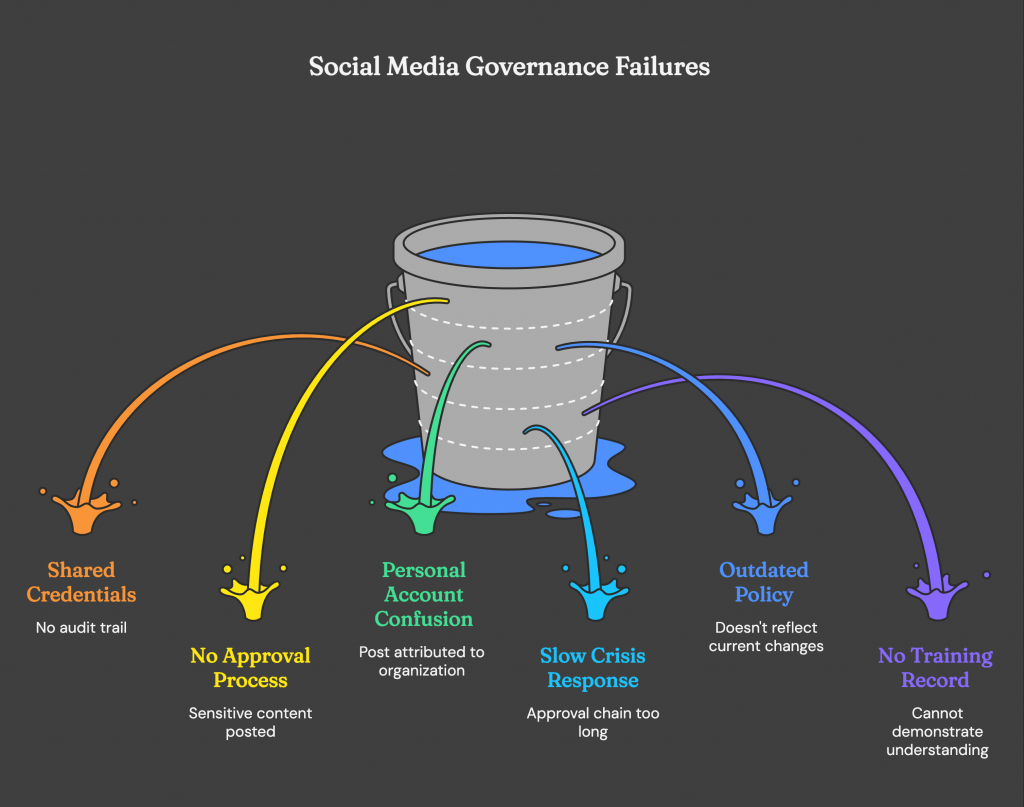
Shared account credentials. A member of staff leaves and takes the password with them, or a shared login circulates across a team without any audit trail of who posted what. The organisation loses control of its own accounts and has no way to evidence what happened and when.
No approval process for sensitive content. A post touching on a live legal matter, a politically sensitive topic, or a recent incident goes out without legal or senior comms sign-off, because the approval workflow only covers routine content and nobody flagged that this content wasn’t routine.
Personal account confusion. A member of staff posts something on their personal account that references the organisation, a service user, or a client, without knowing they logged into the wrong account, or that their privacy setting was set to public. The post gets attributed to the organisation regardless.
Slow crisis response. A reputational incident escalates because the approval chain for a response took longer than the news cycle. By the time the organisation is ready to respond, the story has moved on.
Outdated policy. A governance document written three years ago, that nobody has reviewed since, reflects neither platform changes nor new regulatory requirements nor lessons from previous incidents.
No training record. When a regulator, an auditor, or a public inquiry asks whether staff received governance training and understood the policy, the organisation can’t demonstrate they did.
| Failure | Most common cause | Likely consequence |
| Shared account credentials | No access control policy | Loss of account control, no audit trail |
| No approval for sensitive content | Tiered workflow not defined or communicated | Unauthorised or legally exposed content published |
| Personal account confusion | No employee guidelines | Reputational incident attributed to the organisation |
| Slow crisis response | No pre-agreed protocol | Story escalates before the organisation can respond |
| Outdated policy | No review cycle in place | Framework doesn’t reflect current platforms or regulations |
| No training record | Training treated as optional | No evidential defence in audit or inquiry |
Building Your Social Media Governance Framework: Where to Start
For organisations that don’t yet have a framework, or have one that doesn’t hold up to scrutiny, the sequencing matters as much as the content.
Audit first. Map every social media account the organisation operates: official accounts, service-level accounts, project accounts. Establish who has access, when it was last reviewed, and what’s been published in the last six months. Most organisations discover accounts they’d forgotten about during this exercise. That discovery is the beginning of governance.
Identify the risk profile. Which platforms carry the highest risk for this specific organisation? Which teams or individuals are most likely to generate governance challenges? What are the most plausible incident scenarios? A local authority’s risk profile looks different from an NHS trust’s, which looks different from a financial services firm’s.
Draft the policy. Start with the core policy document, written in plain language, with input from legal, HR, comms, and where relevant the compliance or information governance function. Generic templates are a starting point, not a finished product.
Design the workflows. Map the approval process for each content type and test it against realistic scenarios. Is it fast enough to be practical? Is it secure enough to be defensible? Does it account for out-of-hours publishing and real-time response situations?
Train before you launch. Governance that staff haven’t been trained on offers no protection. Training should precede the policy going live, not follow it months later when something has already gone wrong.
Build the audit trail. Implement the record-keeping and archiving processes at the same time as the framework goes live. Retrospective documentation is harder to produce and easier to challenge.
Build in a review cycle. A quarterly review should sit in the governance calendar as standard. Platforms change, regulations update, and incidents reveal gaps that weren’t visible when the framework was first drafted.
| Step | Key action | Common mistake to avoid |
| Audit | Map all accounts and access | Assuming you already know what exists |
| Risk profile | Identify likely scenarios by team and platform | Using a generic risk framework not tailored to your sector |
| Policy | Draft in plain language with legal and HR input | Downloading a generic template and publishing unchanged |
| Workflows | Map and test tiered approval paths | Assuming staff will figure out the process themselves |
| Training | Train staff before the policy goes live | Running training months after launch as an afterthought |
| Audit trail | Implement archiving from day one | Trying to reconstruct records retrospectively |
| Review cycle | Schedule quarterly governance reviews | Treating the framework as a one-time exercise |
The Role Of Training In Making Governance Stick
Training is what operationalises governance. It’s the mechanism by which policy becomes behaviour, by which staff understand not just what the rules are but why they exist, what a breach looks like in practice, and how to navigate situations that fall into grey areas.
For regulated organisations, documented training also serves an evidential function, demonstrating to a regulator, in an audit, or in a public inquiry that the organisation equipped its people and took its responsibilities seriously.
If your organisation’s governance framework is in place but your team hasn’t been trained on it, or if training happened once three years ago and the policy has changed since, you might be due for an upgrade or refresh.
Work with me—meet your trainer
I’m Dr. Mo Shehu. I hold a PhD in informatics with a research focus in social media analytics, and have spent over a decade advising and training comms teams, public sector organisations, and regulated industries on social media strategy and governance.

My training sessions have been booked by individuals at PwC, Accenture, Unilever, the World Economic Forum, Techstars, Wavemaker, and BDO.
Every session is tailored to your organisation’s structure, regulatory context, and current capability, with no generic slide decks and no off-the-shelf content. Live and virtual delivery are both available.
To discuss the right format for your team, visit shehuphd.com/training.