


The internet will tell you to get a degree in marketing or communications. Some university will suggest enrolling in their programme, while a course platform pushes their certification.
Most of that advice comes from people trying to sell you something, and almost none of it reflects how social media managers actually get hired.
Here’s the honest version: social media management is one of the few careers where your portfolio and your documented results speak louder than your credentials. The fastest path to your first paid role is often simpler than the industry wants you to believe.
I’ve hired social media managers, trained them, and worked alongside them across agencies, in-house teams, and freelance setups for over a decade.
This article covers what the role actually involves, what you need to get hired, and how to build the kind of track record that makes employers and clients take you seriously.
What does a social media manager actually do?
Most people who want to break into this field underestimate the scope of the role. A social media manager isn’t just someone who posts content. Here’s what the job actually covers.
Content creation
You’ll write captions, brief or produce graphics, edit short-form video, and adapt tone and format across platforms. What works on LinkedIn won’t work on TikTok, and part of the job is understanding why.
Strategy
You’ll decide which platforms to prioritise, what to post, how often, and how it connects to the client or employer’s business goals. Posting for the sake of posting is not a strategy, and good managers know the difference.
Community management
Responding to comments and DMs, handling complaints in public, and building engagement rather than just broadcasting content takes up more time than most people expect.
Analytics and reporting
You’ll track performance, identify what’s working and what isn’t, and communicate that to stakeholders in plain language. If you can’t explain your numbers to someone who doesn’t use social media, you’ll struggle to keep clients or justify your role internally.
Paid social basics
Even if you’re not running the ads yourself, understanding how boosted posts and campaign objectives work is increasingly expected at every level of the role.
Platform knowledge
Algorithms, features, and best practices shift constantly. Staying current isn’t optional—it’s part of the job description whether anyone writes it down or not.
Most people start as a social media assistant, handling execution under a more senior manager’s direction, and build from there. The role has a low barrier to entry at the junior level and a high ceiling for people who develop analytical and strategic depth over time.
Do you need a degree to become a social media manager?
Every university article will answer this question in its own interest. Here’s a more useful answer:
A degree in marketing, communications, PR, or journalism gives you a good foundation but isn’t a hiring requirement for most roles, particularly at the assistant or coordinator level.
What hiring managers actually look at:
- Portfolio work
- Demonstrated platform knowledge
- Evidence of results even from personal accounts or voluntary work
- Good writing skills
A degree becomes more relevant at mid-to-senior level, in larger organisations, or in regulated industries. For freelance work, agency roles at smaller firms, and in-house positions at SMEs, it’s rarely the deciding factor.
What qualifications do you need for social media marketing?
Formal qualifications:
| Qualification | Best suited to | Hiring signal |
| Degree in marketing, communications, or PR | Career starters aiming for large employers or agencies | Strong at large corps; less critical at SMEs |
| CIM Certificate or Diploma | Career changers wanting a credentialled UK marketing route | Respected, particularly in B2B and professional services |
| HNC/HND in Digital Marketing | Those who want a structured route without a full degree | Useful for entry-level; less recognised than CIM at senior level |
Platform certifications (free or low cost):
| Certification | Platform focus | Why it helps |
| Meta Blueprint | Facebook and Instagram | Well-recognised; covers both organic and paid |
| LinkedIn Marketing Labs | Useful for B2B-focused roles | |
| Google Analytics / GA4 Certification Training | Cross-platform analytics | Demonstrates analytical capability most job descriptions require |
| HubSpot Social Media Certification | Broad social media strategy | Free, practical, and commonly listed in UK job postings |
| TikTok Academy | TikTok | Increasingly relevant as TikTok becomes a standard channel |
The honest answer on certifications: they signal initiative, and they help fill a CV that’s light on experience. But a HubSpot certification with no portfolio examples will get less attention than three months of documented results from a local business account you managed for free.
Certifications open doors, but results keep you in the room.
What training do you need to be a social media manager?
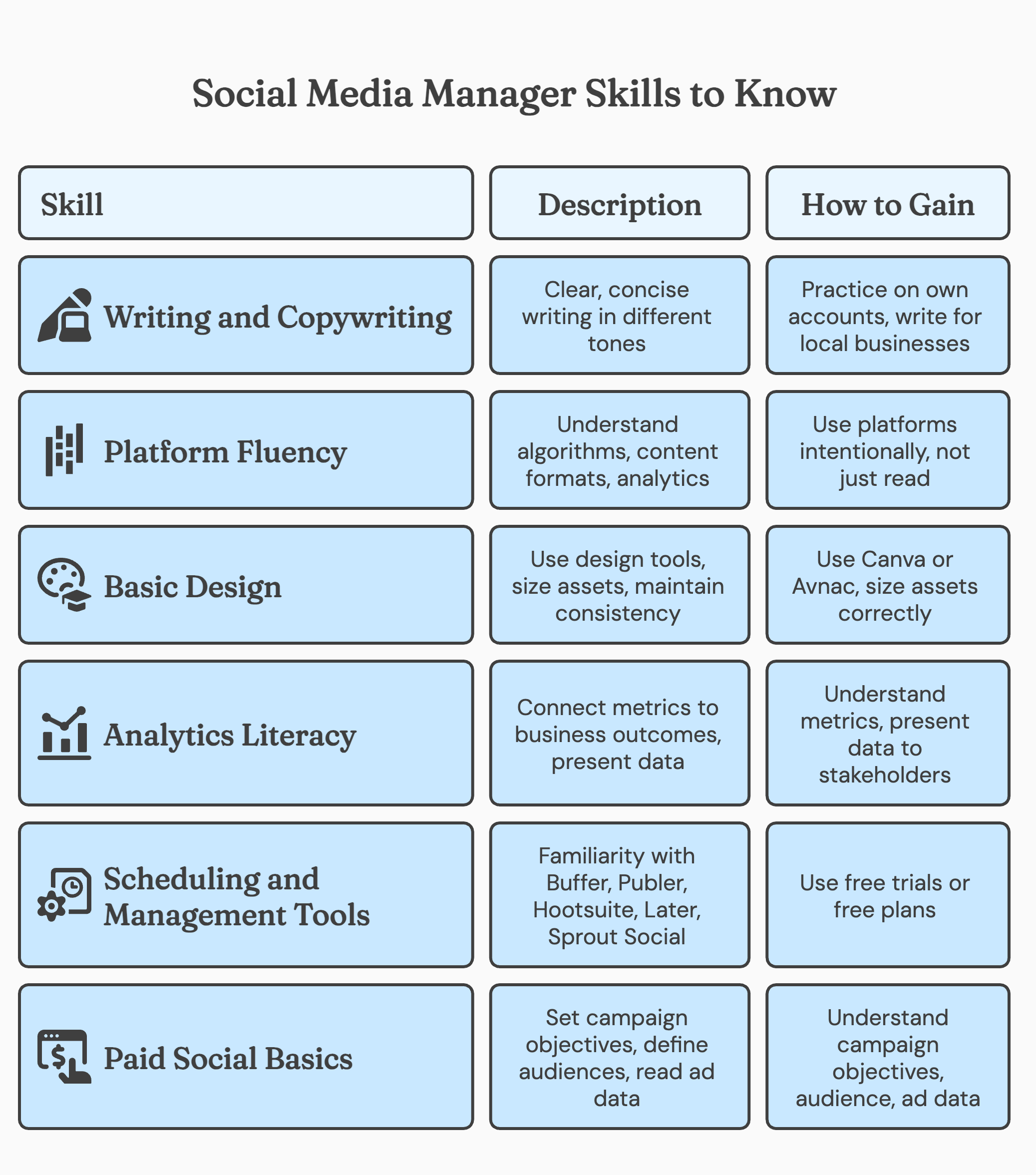
You need to master a few basic skills to excel at social media management. The good news is you don’t have to know everything at once—you’ll learn much of what you need to know on the job.
Writing and copywriting
The most foundational skill in the entire role. You need to write clearly, concisely, and in different tones for different platforms and audiences. Practice on your own accounts, offer to write for local businesses, or produce spec content for brands you admire. No certification teaches this as well as doing it repeatedly on live accounts.
Platform fluency
You need to understand how each major platform’s algorithm works, what content formats it rewards, and how its native analytics dashboard functions.
This comes from using the platforms intentionally, not just from reading about them. You might gravitate toward one or two over the others, and that’s okay—you don’t need to be an expert on all platforms.
Basic design
You also don’t need to be a professional designer. Knowing how to use Canva (or Avnac), size assets correctly for each platform, and maintain visual consistency across a feed makes you significantly more employable at the assistant level and saves your clients or employer money they’d otherwise spend on a designer for routine work.
Analytics literacy
Understanding which metrics connect to business outcomes, and how to present performance data to a non-technical stakeholder, separates functional social media managers from strategic ones. If you want to go deeper on this, the social media analytics guide on this site covers exactly what to track and how to report it.
Scheduling and management tools
Familiarity with Buffer, Publer, Hootsuite, Later, or Sprout Social is expected at most agencies and in-house teams. Most offer free trials or generous free plans you can use to build practical experience before you ever apply for a job.
Paid social basics
Understanding how to set a campaign objective, define an audience, and read ad performance data puts you ahead of most entry-level candidates and makes you more useful to a client or employer from day one—especially those with an actual budget.
If you want structured, tailored training that covers strategy, platform-specific execution, analytics, and reporting rather than a generic online course, my training service offers sessions built around your specific goals and current capability level.
How to get your first social media role
Build a portfolio before you apply
Offer to manage social media for a local business, a charity, a community group, or a friend’s side hustle, ideally in exchange for a testimonial and permission to include results in your portfolio.
Three months of documented results from a live account is more persuasive than any certificate. The account doesn’t have to be big. It just has to show that you had a strategy, executed it, and can talk about what happened.
Grow your own accounts intentionally
Your personal LinkedIn, Instagram, or TikTok is a live portfolio. If you can show scheduled posting, engagement growth, and a clear content rationale on your own accounts, you’ve already demonstrated knowledge of the job.
Start as a social media assistant
Most people don’t begin as a manager, and that’s fine. The assistant or coordinator role is a good entry point: you’ll handle scheduling, community management, and basic reporting under supervision.
Freelance before applying for permanent roles
Picking up one or two small clients builds your portfolio, improves your client communication skills, and often pays better per hour than an entry-level salary for the equivalent work.
Starting at £300 to £500 per month for a basic package covering two platforms, three or four posts per week, and monthly reporting is reasonable for a first client. The goal at this stage is the portfolio and the testimonial, not the rate.
Target SMEs and smaller agencies before large corporates
Smaller businesses give you broader experience faster. At a large corporate, you might manage one platform for a year. At an SME or smaller agency, you’ll be across strategy, content, ads, and reporting from the first month. That breadth builds your skills and your portfolio simultaneously.
The social media career ladder
The career path from entry level to senior roles isn’t always straight, and you might take some interesting detours along the way. All the same, here’s a general path you can expect to take.
| Level | Typical title | Core responsibilities | What moves you forward |
| Entry | Social media assistant / coordinator | Scheduling, community management, basic reporting | Platform fluency, copywriting, initiative |
| Mid | Social media manager | Strategy, content creation, analytics, paid ads, stakeholder comms | Documented results, analytical depth, ownership |
| Senior | Senior manager / strategist | Multi-channel strategy, team management, influencer management, agency liaison, budget oversight | Business acumen, track record of measurable growth |
| Lead | Head of social / social media director | Departmental strategy, commercial accountability, vendor management | Executive presence, cross-functional influence |
| Independent | Freelance consultant / agency founder | Client acquisition, strategy, delivery, business development | Portfolio, specialist reputation, referral network |
The timeline between levels varies considerably depending on sector and organisation size.
Agency progression tends to be faster because the breadth of client work accelerates skill development.
In-house at a large corporate often means slower but more structured progression, with clearer seniority steps and better support systems.
Neither path is better—they develop different strengths and appeal to different personality types.
A note on side hustles and freelancing
If you’re considering social media management as a career change and want to test the field before committing, this is the most practical way to do it.
Social media management is one of the most accessible service businesses to start without upfront investment. You only need a laptop, a client, and the ability to deliver results.
The fastest way to find out whether you enjoy the work is to take on one small client and run their accounts for 60 to 90 days. By the end of that period, you’ll know whether this is something you want to do full time.
The skills that transfer most smoothly from other careers include:
- Writing from journalism, PR, or comms backgrounds
- Data and analytical thinking from finance, research, or academic roles
- Client management from sales, consulting, or account management
- Creative production from design, photography, or video work
If you’re coming from any of those fields, you already have more of the foundational capability than you probably realise.
Breaking into social media management doesn’t require the credentials the internet tries to sell you. It requires demonstrable skill, a portfolio of documented results, and the ability to talk about what you’ve done and why it worked.
The fastest path to your first paid role is building experience on live accounts, learning the tools the industry uses, and showing up with evidence rather than enthusiasm alone.
Work with me
I’m Dr. Mo Shehu. I hold a PhD with a research focus in social media analytics and business intelligence, and I’ve spent over a decade working across agencies, in-house teams, and consulting—training marketing and comms professionals to build the kind of structured social media capability that gets results and advances careers.
Training sessions from Shehu Social have been booked by individuals at PwC, Accenture, Unilever, the World Economic Forum, Techstars, Wavemaker, and BDO.
Sessions are tailored to your current capability and your specific goals, whether you’re just starting out or looking to move into a more senior role. Live and virtual delivery are both available.
To apply or discuss the right format for you, visit shehuphd.com/training.