


Most social media marketing roadmaps treat learning as a single linear path. Pick a platform, take a course, get certified, apply for a job.
That framing works if everyone learning social media marketing is doing it for the same reason—but they’re not, and the path looks genuinely different depending on what you’re trying to accomplish.
This roadmap is built around two starting points: learning social media marketing to build a career, and learning it to grow a business. Both share a common foundation. After that, the emphasis and priorities diverge in ways that matter.
Knowing which track you’re on from the start saves you months of learning the wrong things in the wrong order.
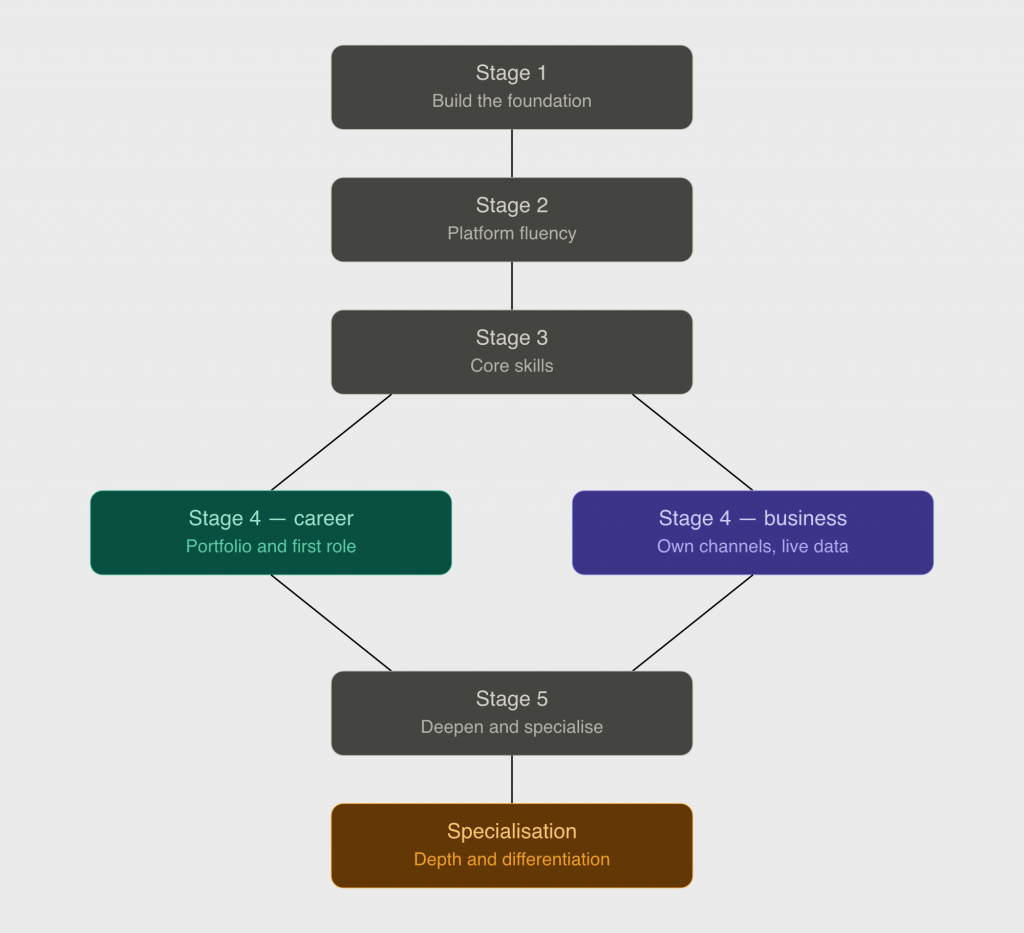
The diagram above shows a five-stage path. Stages 1 to 3 apply to everyone. Stage 4 forks depending on your goal. Stage 5 is where both tracks converge into specialisation.
First: decide what you’re learning this for
Before touching a platform or signing up for anything, get clear on your starting point.
| Track | Your goal | Where to focus |
| Career | Work as a social media manager, strategist, or specialist | Breadth first, then depth—understand how different businesses use social media before specialising |
| Business | Use social media to grow your own organisation | Focus—one or two platforms, deep audience knowledge, measurable outcomes |
Both tracks share the same foundation. Stage one applies to everyone.
Stage 1: build the foundation
Understand what social media marketing actually is
Social media marketing is the practice of using social platforms to reach, engage, and convert an audience in service of specific business goals.
It covers organic content, paid advertising, community management, and analytics—and it sits within a broader digital marketing context that includes SEO, email, and website optimisation.
Understanding how social media fits into that broader picture is what separates strategic thinkers from people who just post content and hope something works.
Learn how social platforms work as systems
Each major platform has its own algorithm, its own content formats, and its own audience behaviour patterns. Spend time on each as a regular user before using them as a marketer.
Notice what gets promoted, what gets buried, and who the algorithm rewards. You’ll learn more in a week of deliberate observation than in a month of reading about it.
Understand the marketing funnel in a social context
Social media content serves different purposes at different stages of the buyer journey. Awareness content reaches new audiences. Engagement content builds relationships with existing ones. Conversion content moves people toward a specific action.
Knowing which stage a piece of content serves—and designing it accordingly—is the foundational skill that separates purposeful social media from posting for the sake of it.
| Funnel stage | Purpose | Example content |
| Awareness | Reach new audiences | Educational posts, viral content, paid reach campaigns |
| Engagement | Build relationships with existing audience | Conversations, behind-the-scenes, polls, community content |
| Conversion | Move people toward a specific action | Testimonials, case studies, offers, direct CTAs |
Get comfortable with basic analytics from day one
You don’t need to be a data analyst. But you do need to understand the difference between surface metrics and decision-driving metrics from the start, so you build the right habits early rather than spending years reporting on the wrong numbers.
The social media analytics guide on this site covers exactly what to track and why.
Stage 2: build platform fluency
For the career track:
Prioritise the platforms your target employers or clients use most. For most B2B agency roles, that means LinkedIn and Meta. For consumer brand roles, Meta and TikTok. For public sector and comms roles, X and Facebook. Build depth on two or three platforms first, then expand. Trying to reach expert level on every platform simultaneously produces shallow knowledge across all of them.
For the business track:
Choose platforms based on where your audience actually is, not where you feel you should be. A local trades business may not need a TikTok strategy. A B2B professional services firm probably doesn’t need to be on Bluesky. The fastest path to results is going deep on one or two platforms your audience uses, rather than maintaining a thin presence across five.
| Platform | Best suited to | Primary content format | Core strength |
| B2B, professional services, recruitment | Text posts, articles, carousels | Thought leadership, B2B lead generation | |
| Instagram & Threads | Consumer brands, hospitality, retail, health, fashion, food, news | Images, Reels, Stories | Visual brand building, community |
| Local businesses, community orgs, events, CPG | Posts, groups, video | Community, local reach, broad demographics | |
| TikTok | Consumer brands targeting under-35s | Short-form video | Organic reach, discovery, entertainment |
| X (Twitter) | Media, tech, PR, real-time commentary | Short posts, threads | Conversation, news, niche communities |
Platform fluency comes from doing, not from watching tutorials.
- Post on your own accounts with strategic intent.
- Analyse what performs and why.
- Use each platform’s native analytics to understand what the algorithm rewards.
- Follow practitioners who share what they’re testing and learning openly.
Stage 3: build core skills deliberately
Rather than treating every skill as equally urgent, here’s the sequence that produces the fastest practical progress.
| Priority | Skill | Why it comes first |
| 1 | Writing | Every other skill builds on the ability to write clearly for different platforms and audiences |
| 2 | Strategy | Connects content decisions to business outcomes—separates managers from operators |
| 3 | Content creation basics | Copy, design, video fundamentals—adapting the same idea across formats |
| 4 | Analytics literacy | Tracking the right metrics and presenting results to stakeholders in plain language |
| 5 | Paid social basics | Campaign objectives, audience targeting, reading ad performance data |
| 6 | Tools and workflow | Scheduling, design, and analytics tools—support a strategy, not a substitute for one |
- Writing
Every other social media skill builds on the ability to write clearly, concisely, and in a voice that fits the platform and the audience. No tool substitutes for this. Practice by writing every day: captions, LinkedIn posts, short-form video scripts, content briefs. Read widely. Edit your own work until it’s tighter than the first draft.
- Strategy
Understanding how to set a social media goal, choose the right platforms, define an audience, and build a content approach that connects to business outcomes. This is the skill that separates a social media manager from a social media operator—and the one most junior practitioners are missing when they first enter the field.
- Content creation basics
Writing copy for different formats, using design tools like Canva for graphics, understanding basic video composition, and knowing how to adapt the same idea across different platforms. You don’t need professional production quality at this stage. You need to understand what makes content work on each format and why.
- Analytics literacy
Tracking the right metrics, understanding what they mean, and presenting performance to a stakeholder in plain language. The social media analytics articles on this site cover this in detail if you want to go deeper.
- Paid social basics
Understanding how campaign objectives work, how audience targeting functions, and how to read ad performance data. Even if you’re not running ads yet, knowing how paid social works makes you a more effective organic practitioner and a stronger hire or collaborator.
- Tools and workflow
Scheduling tools, design tools, analytics dashboards, and content calendars are workflow aids. They support a strategy you’ve already developed. Learning them before you understand strategy produces a very organised version of the wrong approach.
Stage 4: build real experience
For the career track:
The fastest path to your first paid role or client is a portfolio of documented results from live accounts. Offer to manage accounts for a local business, a charity, or a community project in exchange for a testimonial and permission to share results. Three months of real data from a real account is more persuasive than any certification. The social media manager career guide on this site goes into more detail on exactly how to approach this.
For the business track:
Run your own channels as a learning environment before you lock in a strategy. Post on a consistent schedule for 60 to 90 days, review what performs and what doesn’t, and use that data to build your first proper content plan. The platforms reward experimentation, and your own accounts are the lowest-cost place to do it.
For both tracks:
Document what you try and what happens. Keep a simple record of what you posted, the results it produced, and what you’d do differently. That documentation becomes your portfolio, your case study library, and your analytical foundation simultaneously.
| Track | Stage 4 goal | How to get there |
| Career | A portfolio of documented results from live accounts | Manage accounts for a local business, charity, or personal project |
| Business | A data-informed content strategy built on 60-90 days of real performance | Post consistently, review analytics, iterate before committing to a plan |
Stage 5: deepen and specialise
At some point, breadth stops being an asset and depth becomes the competitive advantage. The main specialisation paths in social media marketing include the following.
| Specialisation | Best suited to | What it develops |
| Content strategy | Writers and creative thinkers | Long-term content planning, brand voice, editorial systems |
| Paid social and performance | Analytical and data-driven practitioners | Campaign management, audience targeting, ROI reporting |
| Social media analytics | Data-curious practitioners | Measurement frameworks, reporting, business intelligence |
| Community management | Relationship-oriented practitioners | Audience engagement, moderation, loyalty programmes |
| Influencer and creator partnerships | Connected, culturally fluent practitioners | Campaign briefs, creator relationships, performance tracking |
| Social media governance and policy | Comms and compliance-adjacent practitioners | Policy frameworks, approval workflows, regulated industry knowledge |
How to choose: follow what you’re naturally curious about and what the market rewards. Look at job descriptions one level above where you currently are and notice which skills appear most often in the highest-compensated roles.
Most people are ready to start specialising after 12 to 18 months of broad practice. Specialising too early limits your understanding of how the whole system works. Staying generalist too long keeps you undifferentiated in a market that increasingly values specific, demonstrable expertise.
What to skip
Chasing every new platform. Every few months a new platform gets declared the future of social media. Build on established platforms with proven audiences before adding new ones. Experimentation is useful; scattered attention is expensive.
Collecting certifications without building a portfolio. Certifications signal initiative. Results signal capability. A stack of certificates with no live examples of your work doesn’t move the needle with hiring managers or prospective clients. Get the certifications if they’re useful, but treat them as a supplement to your portfolio, not a substitute for it.
Trying to be everywhere at once. The fastest way to make slow progress is maintaining an active presence on five platforms simultaneously without the capacity to do any of them well. Pick one or two, do them well, and expand from a position of strength.
Measuring everything equally. Tracking every metric your platform dashboard offers produces noise rather than insight. Decide which two or three metrics connect to your specific goals and track those on a consistent schedule. Everything else is context, not signal.
A social media marketing learning roadmap is only as useful as the clarity of your destination. Know whether you’re learning to build a career or grow a business, work through the foundational stages before branching into specialisation, and spend more time doing the actual work than planning to do it. The people who get good at this quickly are almost always the ones who started on live accounts before they felt ready.
Work with me—meet your trainer
I’m Dr. Mo Shehu. I hold a PhD with a research focus in social media analytics and business intelligence, and I’ve spent over a decade training marketing and comms professionals at every stage of this journey—from career starters building their first portfolio to senior managers developing strategic capability for their teams.

Training sessions from Shehu Social have been booked by individuals at PwC, Accenture, Unilever, the World Economic Forum, Techstars, Wavemaker, and BDO.
Sessions are tailored to where you are and where you’re trying to get to. Live and virtual delivery are both available. Visit shehuphd.com/training to apply or find out more.